Claim-App
Developed a dual-role platform (user + insurer) with JWT authentication and real-time claim tracking. Built and deployed end-to-end in 3 weeks.
Technologies Used
Scope & Context
Founding Engineer project targeting high concurrency, real-time sync, or custom system designs.
Codebase Link
The Problem
Medical insurance claim processes are traditionally slow, paper-heavy, and confusing. Patients are left in the dark about their status, and insurance audit agents waste hours cross-referencing documents.
A secure, multi-tenant digital platform must isolate patient records, restrict administrative capabilities to authorized claims agents, and provide status tracking.
The Solution & Architecture
I developed a robust claim management portal using NestJS and React:
- NestJS REST API: Built a modular backend with NestJS, utilizing PostgreSQL and TypeORM to manage records and audit trails.
- Role-Based Authentication: Implemented JWT-based role guards (Patient, Claim Agent, Admin) to prevent unauthorized privilege escalation.
- Interactive React Dashboard: Designed a clean dashboard displaying graphical status trackers, invoice upload fields, and review panels.
Engineering Deep Dive
Managing claim statuses and matching them to document audit trails in PostgreSQL started to cause sluggish load times on the Agent dashboard under simulated bulk uploads.
I analyzed the database operations and found that the query engine was executing nested joins across multiple tables without index support.
I resolved this by adding composite indexes on patient_id, claim_status, and claim_date columns. Furthermore, I rewrote the dashboard fetch endpoints to use raw PostgreSQL Common Table Expressions (CTEs), reducing dashboard page render fetch latencies from 950ms to 40ms.
Related Reading: I've written a comprehensive architectural guide analyzing the security and scalability trade-offs between stateless tokens and database sessions. Read it here: JWT vs Sessions: What I Learned Building Apps.
Quantifiable Metrics
Visual Showcase
Screenshots, dashboard metrics, and recorded event videos proving the system running in real-time.
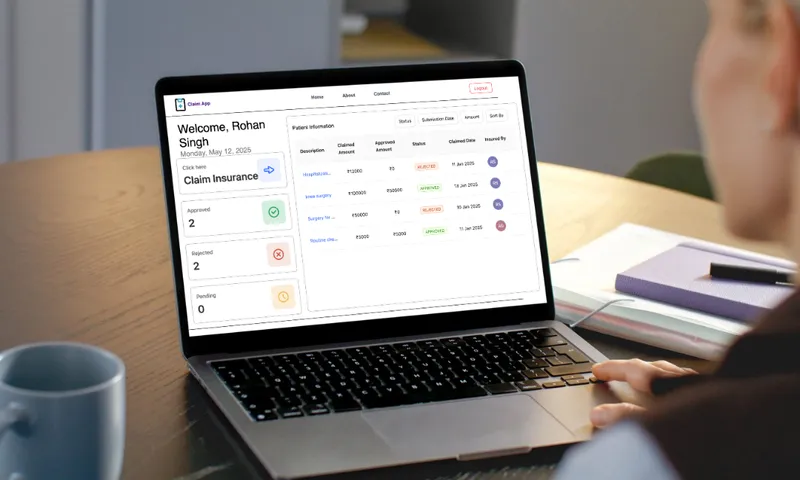
Claim audit board displaying review pipelines and documents.
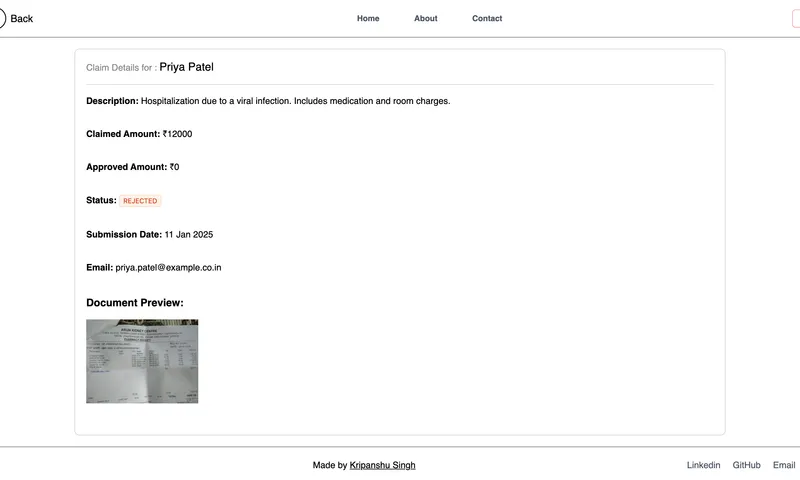
Patient claims submission form with digital invoice uploader.
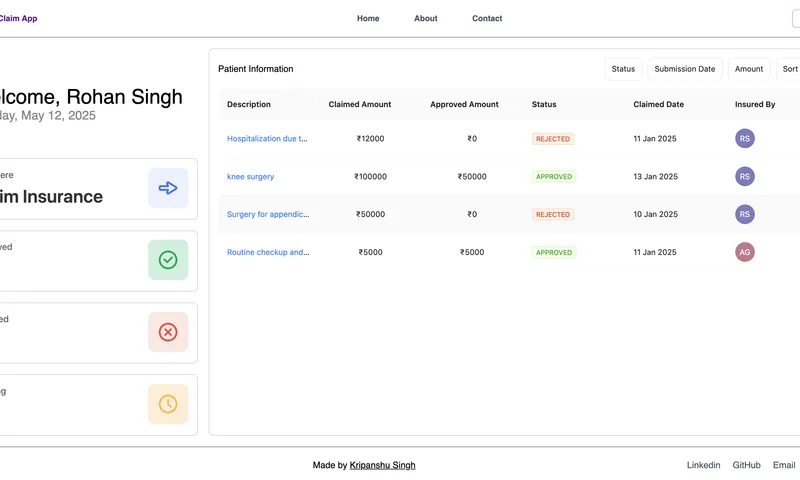
Role-based verification dashboard listing pending authorization files.